
You’ve thought about booking a private chef. The food looks incredible. Your guests would love it. But then the questions start creeping in.
Where does the chef go while you’re eating? Do you need fancy plates? Is it going to be weird having a stranger cooking in your kitchen? What if something goes wrong? Do you have to stay in the kitchen and help?
Most people don’t ask these things out loud. They just scroll past the pictures and think, “Maybe someday.” But if you’ve ever wondered what a private chef evening actually looks like from the moment I arrive to when I leave, this is for you. No mystery. No guesswork. Just what happens.
How It All Starts (A Few Weeks Before)
The process doesn’t begin the night of your dinner. It starts a few weeks earlier, when you and your guests choose your menu.
You don’t order individually like you’re at a restaurant. Instead, you pick one starter, one main, and one dessert from the seasonal menu that everyone will eat. Everyone at the table gets the same beautiful plate. If someone has a dietary restriction, I keep two protein options available. A vegetarian guest? I can make a Vegetarian Stuffed Pepper instead of the Sous Vide Beef Tenderloin. Pescatarian? Pan Seared Atlantic Salmon instead. I work around it. That’s included.
When you book, you’re choosing between three packages. The Classic Dinner runs $159 per person. The Signature Dinner, which is the most popular, is $199 per person. The Chef’s Table experience is $259 per person. One all-inclusive price. No separate food bill. No hourly math. Food and labour are built in. The only requirement is a minimum of $800.
You put down a 15% deposit. I show up and handle the rest.
The Day Of: What I Do Before You Even Know I’m There
The morning of your dinner, I shop. Not you. Me. I hit the market and grab exactly what’s needed for your menu. East Coast Mussels if that’s your starter. Prosciutto for Wrapped Pork Tenderloin if that’s your main. Whatever you chose. The food cost is included in your package price. You don’t get an invoice for groceries. You already paid.
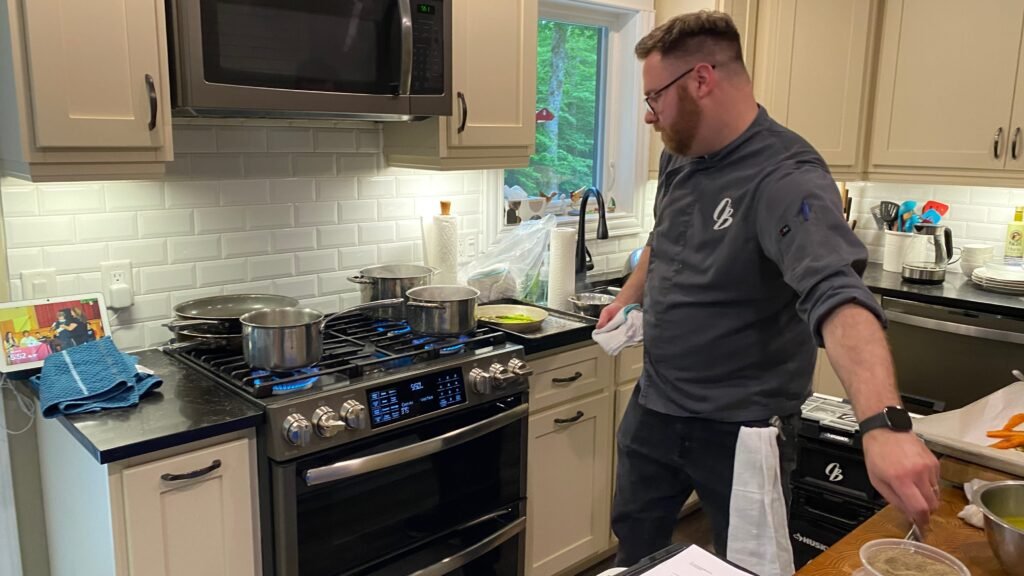
I arrive two to three hours before guests are supposed to sit down. I walk in with everything. My knives. My cutting boards. My pans. I bring everything I need. The only things I need from you are basic: a clean kitchen with a working oven, counter space to work on, some fridge room depending on the dessert, and your plates, cutlery, and glassware. I also typically ask that you set the table because the host usually has a specific vision of how it should look, and that isn’t built into my timing.
That’s it. You don’t need a commercial kitchen. You don’t need a six-burner range. A normal home kitchen works fine. I’ve cooked in tiny apartments and sprawling houses. What matters is that it works and it’s clean.
When I start prepping, you can be anywhere. In the living room with your guests. Finishing getting ready. Having a drink. Opening wine. Or watching and asking questions. But you don’t NEED to be in the kitchen. I don’t need your help. You’re not my sous chef. You’re my host. There’s a difference.
The Timing: How the Evening Actually Unfolds
This is where people get confused. They imagine a private chef evening as stressful. Everyone arriving at different times. Food getting cold while you chat. The chef disappearing into the kitchen and leaving the host to figure out what’s happening.
It doesn’t work that way.
We set a serving time before the event. If you say food at 6, the food is ready at 6. I arrive early and work backwards from that time so everything is prepped, timed, and ready to plate when your guests sit down.
Let’s say you’re hosting eight people and you want dinner at 7 p.m. The food is ready at 7. About five minutes before, I give you a heads up. “Ladies and gentlemen, dinner will be served in five minutes, if you’d like to start making your way to the table.” That’s your cue. Your guests grab their wine, take their seats, and I serve.
You don’t have to time anything around me. I time everything around you. The serving time was set in advance. I built my prep schedule around it. When the moment comes, the food is ready and your guests sit down to a beautiful plate.
From there, the courses flow. I’m not rushing anyone. I’m not hovering. I’m in the kitchen plating the next course while your guests are eating, talking, and enjoying the evening. That’s the whole point.
Between courses, you pour drinks. I clear the plates. The kitchen is my responsibility. You’re not doing anything except enjoying the company.
What Your Kitchen Looks Like While I’m Cooking
This is the part people worry about. They think their kitchen will be a disaster. Dishes piled high. Flour everywhere. Pans scattered. Their nice kitchen turned into a war zone.
It doesn’t happen that way.
I clean as I go. I’m not making a mess and leaving it. A dirty station makes cooking harder. Dirty pans slow me down. Clean workspace is fast workspace. By the time the first course goes to the table, my station looks controlled. You probably won’t see it. You’ll be in another room. But if you poke your head in, it doesn’t look chaotic.
After the Last Course: The Part People Don’t Think About
Here’s what happens after dessert when a lot of people expect the evening to just fade out. I don’t leave your kitchen looking like I cooked there.
I do the dishes. I wipe the counters. I put equipment away. I take the garbage with me. The only thing I don’t wash is your glasses. When I leave, your kitchen is cleaner than when I arrived. That’s not a bonus. That’s standard. You should be able to pour a coffee the next morning without seeing any sign that I was ever there. That’s how it works.
The Thing That Actually Matters
If you book with me, I back it up with a promise. If any course doesn’t meet your expectations, you get your money back. One hundred percent. No questions. No middleman. That’s what 25 years in professional kitchens and a hundred-plus TV appearances means to me: I know what I’m doing and I’m confident enough to guarantee it.
But here’s what I’ve learned after all these years. The best part of a private chef evening isn’t actually the Seared Scallops or the Sous Vide Beef Tenderloin or the Dark Chocolate Espresso Ganache Cups.
The best part is that you got to sit down with the people you care about.
No jumping up to check on something. No stress about timing. No wondering if the food is good. No kitchen disasters. You just got to be present. And they got to eat incredibly well. That combination doesn’t happen often in real life.
That’s why people book again. That’s why they recommend me to their friends. Because they finally had an evening where everything just worked.
If that sounds like something you need, let’s talk. Tell me what occasion you’re thinking about. Tell me how many people. I’ll walk you through the menu choices and we’ll set a date that works.
Ready to book your private chef evening?
Email me at bookings@chefbenkelly.com or call (782) 289-0022. Let’s make your next gathering something your guests actually remember.